Chapter 1 Special Relativity
Question 5: Time Dilation: Two observers, A on earth and B in a spacecraft whose speed is 2.00×10⁸m/s, both set their watches to the same time when the ship is abreast of the earth. (a) How much time must elapse by A's reckoning before the watches differ by 1.00s? (b) To A, B's watch seems to run slow. To B, does A's watch seem to run fast, run slow, or keep the same time as his own watch?
Question 41: Mass and Momentum: In its own frame of reference, a proton takes 5 min to cross the Milky Way galaxy, which is about 105 light-years in diameter. (a) What is the approximate energy of the proton in electron volts? (b) About how long would a proton take to cross the galaxy as measured by an observer in the galaxy's reference frame?
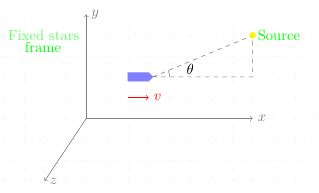
Question 53: Lorentz Transformation: A spacecraft moving in the \(+x\) direction receives a light signal from a source in the \(xy\) plane. In the reference
frame of the fixed stars, the speed of the spacecraft is \(v\) and the signal arrives at an angle \(\theta\) to the axis of the spacecraft. (a) With the help of the Lorentz transformation find the angle
\(\theta^{\,\prime}\) at which the signal arrives in the reference frame of the spacecraft. (b) What would you conclude from this result about the view of the stars from a porthole on the side of the spacecraft?
Chapter 2 Particle Properties of Waves
Question 15: Photoelectric Effect: 1.5mW of 400nm light is directed at a photoelectric cell. If 0.10 percent of the incident photons produce photoelectrons, find the current in the cell.
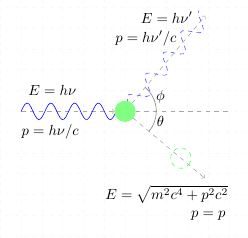
Question 37: Compton Effect: A photon whose energy equals the rest energy of the electron undergoes a Compton collision with an electron. If the electron moves
off at an angle of 40\(^{\circ}\) with the original photon direction, what is the energy of the scattered photon?
Question 53: Photons and Gravity: When a nucleus emits a photon, it recoils in the opposite direction. (a) The \(^{57}_{27}\)Co nucleus decays by K capture to \(^{57}_{26}\)Fe, which then emits a photon in losing 14.4keV to reach its ground state. The mass of a \(^{57}_{26}\)Fe atom is 9.5×10⁻²⁶kg. By how much is the photon energy reduced from the full 14.4keV available as a result of having to share energy and momentum with the recoiling atom? (b) In certain crystals the atoms are so tightly bound that the entire crystal recoils when a gamma-ray photon is emitted, instead of the individual atom. This phenomenon is known as the Mossbauer effect. By how much is the photon energy reduced in this situation if the excited \(^{57}_{26}\)Fe nucleus is part of a 1.0g crystal? (c) An experiment measures the increase in frequency of photons falling in a gravitational field. What is the original frequency and change in frequency of a 14.4keV gamma-ray photon after it has fallen 20m near to the earth's surface?
Chapter 3 Wave Properties of Particles
Question 5: De Broglie Waves: By what percentage will a non-relativistic calculation of the de Broglie wavelength of a 100keV electron be in error?
Question 39: Uncertainty Principle: The frequency of oscillation of a harmonic oscillator of mass \(m\) and spring constant \(C\) is \(\nu = \sqrt{C/m}/2\pi\). The energy of the oscillator is \(E= p^2/2m + Cx^2/2\), where \(p\) is its momentum when its displacement from the equilibrium position is \(x\). In classical physics the minimum energy of the oscillator is \(E_{min}=0\). Use the uncertainty principle to find an expression for \(E\) in terms of \(x\) only and show that the minimum energy is actually \(E_{min} = h\nu/2\) by setting \(dE/dx=0\) and solving for \(E_{min}\).
Chapter 4 Atomic Structure
Question 9: The Bohr Atom: The fine structure constant is defined as \(\alpha = e^2/2\epsilon_0 h c\). (a) Show that \(\alpha=v_1/c\) where \(v_1\) is the velocity of the electron in the ground state of the Bohr atom. (b) Show that the value of \(\alpha\) is very close to 1/137 and is a pure number with no dimensions. (c) Show that \(\alpha a_0 = \lambda_c/2\pi\), where \(a_0\) is the radius of the ground-state Bohr orbit and \(\lambda_C\) is the Compton wavelength of the electron.
Question 35: Nuclear motion: (a) Derive a formula for the energy levels of a hydrogenic atom, which is an ion such as He\(^+\) or Li\(^{2+}\) whose nuclear charge is \(+Ze\) and which contains a single electron. (b) Sketch the energy levels of the He\(^+\) ion and compare them with the energy levels of the H atom. (c) An electron joins a bare helium nucleus to form a He\(^+\) ion. Find the wavelength of the photon emitted in this process if the electron is assumed to have had no kinetic energy when it combined with the nucleus.
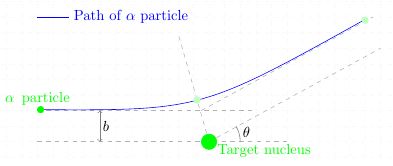
Question 41: Rutherford Scattering: A 5.0MeV alpha particle approaches a gold nucleus with an impact parameter of 2.6×10\(^{-3}\)m. Through what angle will it
be scattered?
Chapter 5 Quantum Mechanics
Question 5: Quantum Mechanics: The wave function of a certain particle is \(\psi = A\,cos^2 x\) for \(-\pi/2\lt x\lt \pi/2 \) (a) Find the value of \(A\). (b) Find the probability that the particle be found between \(x=0\) and \(x=\pi/4\).
Question 31: Harmonic Oscillator: Find the expectation values \(\langle x \rangle\) and \(\langle x^{2} \rangle\) for the first two states of a harmonic oscillator.
Question 35: Harmonic Oscillator: Schrodinger's equation for a harmonic oscillator is, with \(U=\tfrac{1}{2}kx^2\) \[\frac{d^2\psi}{dx^2} + \frac{2m}{\hbar^2}\left(E - \frac{1}{2}kx^2\right)\psi = 0\] Verify the following solution for \(n=2\) \[\psi_n = \left(\frac{2m\nu}{\hbar}\right)^{1/4} (2^n n!)^{-1/2} \,\,H_n(y)e^{-y^2/2}\] Where \[ y= \left(\frac{1}{\hbar} \sqrt{km}\right)^{1/2}x\quad\quad\text{and}\quad\quad H_2(y) = 4y^2-2\]
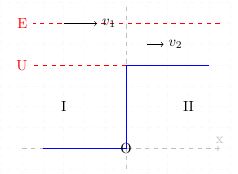
Question 37: The Tunnel Effect: Consider a beam of particles of kinetic energy \(E\) incident on a potential step at \(x=0\), that is \(U\) high, where \(E\gt U\).
Schrodinger's equation gives the solutions:
\[\psi_I = A e^{ik_1 x} + B e^{-ik_1 x}\quad\quad\psi_{II} = C e^{ik_2 x} + D e^{-ik_2 x}\]
(a) Explain why \(D=0\). (b) Show that the transmission probability here is \(T=CC^*v_2/AA^*v_1 = 4k_1^2/(k_1+k_2)^2\). (c) A 1.00mA beam of electrons moving at 2.00×10⁶ m/s enters a region with a
sharply defined boundary in which the electron speeds are reduced to 1.00×10\(^6\)m/s by a difference in potential. Find the transmitted and reflected currents.
Chapter 6 Quantum Theory of the Hydrogen Atom
Question 3: Quantum Numbers: The wave functions of the hydrogen atom are given by \(\psi =R_{nl}\Theta_{lm_l}\Phi_{m_l}\) where \(n\), \(l\), \(m_l\) are the principal, orbital and magnetic quantum numbers respectively. Show that \[R_{10}(r) = \frac{2}{a_0^{3/2}}\, e^{-r/a_0}\] is a solution to Schrodinger's equation for \(R\) \[\frac{1}{r^2}\,\frac{d}{dr}\left(r^2\frac{dR}{dr}\right) + \left[\frac{2m}{\hbar^2}\left(\frac{e^2}{4\pi\epsilon_0 r} + E\right) - \frac{l(l+1)}{r^2}\right]R = 0\] and that it is normalized.
Question 13: Orbital Quantum Number: Find the percentage difference between the maximum value of L and Lz for an atomic electron in the p,
d and f states.
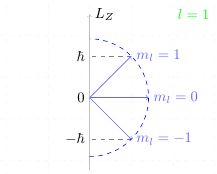
Question 23: Electron Probability Density: Unsold's theorem states that for any value of the orbital quantum number \(l\), the probability densities summed over all possible states from \(m_l =-l\) to \(m_l =+l\) yield a constant independent of angles \(\theta\) or \(\phi\) that is \[\sum_{m_l=-l}^{+l} |\Theta|^2 |\Phi|^2 = \text{constant}\] Every closed subshell atom or ion has a spherically symmetric distribution of electric charge. Verify Unsold's theorem for \(l=0\), \(l=1\) and \(l=3\).
Question 31: Zeeman effect: Find the minimum magnetic field needed for the Zeeman effect to be observed in a spectral line of 400nm wavelength when a spectrometer whose resolution is 0.010nm is used.
Chapter 7 Many-Electron Atoms
Question 1: Electron Spin: A beam of electrons enters a uniform 1.20T magnetic field. (a) Find the energy difference between electrons whose spins are parallel and antiparallel to the field. (b) Find the wavelength of radiation that can cause the electrons whose spins are parallel to the field to flip so that their spins are antiparallel.
Question 23: Spin-Orbit Coupling: The spin-orbit effect splits the \(3P \rightarrow 3S\) transition in sodium into two lines, 589.0nm corresponding to \(3P_{3/2}\rightarrow 3S_{1/2}\) and 589.6nm corresponding to \(3P_{1/2}\rightarrow 3S_{1/2}\). Use these wavelengths to calculate the effective magnetic field experienced by the outer electron in the sodium atom as a result of its orbital motion.
Question 37: Total Angular Momentum: The magnetic moment \(\boldsymbol\mu_J\) of an atom in which \(LS\) coupling holds has the magnitude \[\mu_J = \sqrt{\mathsf{J(J+1)}} g_J \mu_B \] where \(\mu_B = e \hbar / 2m \) is the Bohr magneton and \[g_J = 1 + \mathsf{\frac{J(J+1) - L(L+1) + S(S+1)}{2J(J+1)}}\] is the Lande g factor. (a) Derive this result with the help of the law of cosines starting from the fact that averaged over time, only the components of \(\boldsymbol\mu_L\) and \(\boldsymbol\mu_S\) parallel to J contribute to \(\boldsymbol\mu_J\). (b) Consider an atom that obeys \(LS\) coupling that is in a weak magnetic field \(B\) in which coupling is preserved. How many substates are there for a given value of \(\mathsf{J}\)? What is the energy difference between substates?
Chapter 8 Molecules
Question 9: Rotational Energy Levels: The rotational spectrum of HCl contains the following wavelengths: \[\begin{align*} 12.03 \times 10^{-5}\, m\\ 9.60 \times 10^{-5}\, m\\ 8.04 \times 10^{-5}\, m\\ 6.89 \times 10^{-5}\, m\\ 6.04 \times 10^{-5}\, m \end{align*}\] If the isotopes involved are \(^1\)H and \(^{35}\)Cl, find the distance between the hydrogen and chlorine nuclei in an HCl molecule.
Question 13: Rotational Energy Levels: For large quantum numbers, the frequency of radiation for a hydrogen atom that drops from an initial state of quantum number \(n\) to a final state of quantum number \(n-1\) is equal to the classical frequency of revolution of an electron in the \(n^{th}\) Bohr orbit. This is an example of Bohr's correspondence principle. Show that a similar correspondence holds for a diatomic molecule rotating about its centre of mass.
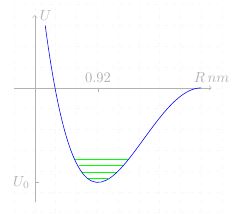
Question 17: Vibrational Energy Levels: The force constant of the 1H19F molecule is approximately 966N/m. (a) Find the frequency of vibration
of the molecule. (b) The bond length is approximately 0.92nm. Plot the potential energy of this molecule versus internuclear distance in the vicinity of 0.92nm and show the vibrational energy levels.
Chapter 9 Statistical Mechanics
Question 5: Maxwell-Boltzmann Statistics: The moment of inertia of a H2 molecule is 4.64 × 10-48kgm2 (a) Find the relative populations of the \(J=\)0, 1, 2, 3, and 4 rotational states at 300K. (b) Can the populations of the \(J\)=2 and \(J=\)3 states ever be equal? If so, at what temperature does this occur?
Question 12: Molecular Energies in an Ideal Gas: Verify that the most probable speed of an ideal gas molecule is \(\sqrt{2kT/m}\,.\)
Question 29: Planck Radiation Law: Considering the sun as a blackbody at 6000K, estimate the proportion of its total radiation that consists of yellow light between 570nm and 590nm.
Question 39: Electron-Energy Distribution: The Fermi energy in silver is 5.51eV. (a) What is the average energy of free electrons in silver at 0K? (b) What temperature is necessary for the average molecular energy in an ideal gas to have this value? (c) What is the speed of an electron with this energy?
Question 49: Electron-Energy Distribution: The Bose-Einstein and Fermi-Dirac distribution functions both reduce to the Maxwell-Boltzmann function when \(e^\alpha e^{\epsilon /kT}\)>> 1. For energies in the neighbourhood of kT, this approximation holds if \(e^\alpha\)>>1. Helium atoms have spin 0 and so obey Bose-Einstein statistics. Verify that \(f(\epsilon) \approx 1/e^\alpha e^{\epsilon /kT} \approx Ae^{-\epsilon /kT}\) is valid for He at STP (20\(^\circ\)C and atmospheric pressure, when the volume of 1kmol of any gas is ≈22.4m3) by showing that A<<1 under these circumstances.
Question 53: Dying Stars: Consider a white dwarf star whose mass is half that of the sun and whose radius is 0.01 that of the sun. Assume it consists of completely ionized carbon atoms (mass 12u), so that there are six electrons per nucleus, and its interior temperature is 107 K. (a) Find the Fermi energies of the carbon nucleus gas and of the electron gas. (b) Compare these energies with kT to see whether each gas is degenerate or nondegenerate.
Chapter 10 The Solid State
Question 3: Ionic Crystals: (a) The ionization energy of potassium is 4.34eV and the electron affinity of chlorine is 3.61eV. The Madelung constant for the KCl structure is 1.748 and the distance between ions of opposite sign is 0.314nm. On the basis of these data only, compute the cohesive energy of KCl. (b) The observed cohesive energy of KCl is 6.42eV per ion pair. On the assumption that the difference between this figure and that obtained in (a) is due to the exclusion-principle repulsion, find the exponent \(n\) in the formula \(Br^{-n}\) for the potential energy arising from this source.
Question 11: Metallic Bond: Silver has an atomic mass of 108u, a density of 10.5×10³kg/m3, and a Fermi energy of 5.51eV. On the assumptions that each silver atom contributes one electron to the electron gas and that the mean free path of the electrons is 200 atom spacings, estimate the resistivity of silver. (The actual resistivity of silver at 20\(^{\circ}\)C is 1.6×10⁻⁸\(\Omega\)m).
Question 21: Energy Bands: Phosphorus is present in a germanium sample. Assume that one of its five valence electrons revolves in a Bohr orbit around each P\(^+\) ion in the germanium lattice. (a) If the effective mass of the electron is 0.17me and the dielectric constant of germanium is 16, find the radius of the first Bohr orbit of the electron. (b) The energy gap between the valence and conduction bands in germanium is 0.65eV. How does the ionization energy of the above electron compare with this energy and with kT at room temperature?
Question 23: Energy Bands: The effective mass \(m^*\) of a current carrier in a semiconductor can be directly determined by means of a cyclotron resonance experiment in which the carriers (whether electrons or holes) move in helical orbits about the direction of an externally applied magnetic field \(B\) An alternating electric field is applied perpendicular to \(B\), and the resonant absorption energy from this field occurs when its frequency \(\nu\) is equal to the frequency of revolution \(\nu_c\) of the carrier. (a) Derive an equation for \(\nu_c\) in terms of \(m^*,\,e\) and \(B\). (b) In a certain experiment, \(B\,\)=0.1T and maximum absorption is found to occur at \(\nu\) = 1.4×10¹⁰Hz. Find \(m^*\). (c) Find the maximum orbital radius of a charge carrier in this experiment whose speed is 3×10⁴m/s.
Chapter 11 Nuclear Structure
Question 9: Some Nuclear Properties: A system of a million distinguishable protons is in thermal equilibrium at 20\(^\circ\)C in a 1.00T magnetic field. More of the protons are in the lower energy spin-up state than in the higher energy spin-down state. (a) On the average, how many more? (b) Repeat the calculation for a temperature of 20K. (c) What do these results suggest about how strongly such a system will absorb \(em\) radiation at the Lamour frequency? (d) Could such a system in principle be used as the basis of a laser? If not, why not?
Question 17: Binding Energy: Find the energies needed to remove a neutron from He\(^4_2\), then to remove a proton, finally to separate the remaining neutron and proton. Compare the total with the binding energy of He\(^4_2\).
Question 23: Liquid-Drop Model: The coulomb energy of Z protons uniformly distributed throughout a spherical nucleus of radius R is given by \[ E_C = \frac{3}{5}\,\frac{Z(Z-1)e^2}{4\pi \epsilon_0 R} \] (a) On the assumption that the mass difference \(\Delta\)M between a pair of mirror isobars is entirely due to the difference \(\Delta\)m between the \(^1_1\)H and neutron masses and to the difference between their coulomb energies, derive a formula for R in terms of \(\Delta\)M, \(\Delta m\) and Z, where Z is the atomic number of the nucleus with the smaller number of protons. (b) Use this formula to find the radii of the mirror isobars \(^{15}_{\,7}\)N and \(^{15}_{\,8}\)O.
Question 29: Shell Model: A simplified model of the deuteron consists of a neutron and a proton in a square potential well 2fm in radius and 35MeV deep. Is this model consistent with the uncertainty principle?
Chapter 12 Nuclear Transformations
Question 19: Half-Life: The heaviest nuclei are probably created in supernova explosions and become distributed in galactic matter from which later stars (and their planets) form. Under the assumption that equal amounts of the 235U and 238U now in the earth were created in this way in the same supernova, calculate how long ago this occurred from their respective observed abundances of 0.7 and 99.3 percent and respective half-lives of 7.0×10⁸y and 4.5×10⁹ y.
Question 41: Cross Section: Natural cobalt consists entirely of the isotope 59Co whose cross section for thermal neutron capture is 37b (barn). When 59Co absorbs a neutron, it becomes 60Co, which is gamma-radioactive with a half-life of 5.27y. If a 10.0g cobalt sample is exposed to a thermal-neutron flux of 5×10¹⁷ neutrons/m2s for 10.0h, what is the activity of the sample afterward?
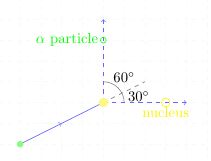
Question 49: Nuclear Reactions: An alpha particle collides elastically with a stationary nucleus and continues on at an angle of 60° with respect to its
original direction of motion. The nucleus recoils at an angle of 30° with respect to this direction. What is the mass number of the nucleus?
Question 59: Nuclear Reactions: A particle of mass \(m_1\) and kinetic energy KE1 collides head on with a stationery particle of mass \(m_2\). The two particles then move apart with the target particle having the kinetic energy KE2'. (a) Use conservation of momentum and conservation of kinetic energy in a non-relativistic calculation to show that \[KE^{\prime}_2/KE_1 = 4(m_2/m_1)/(1 + m_2/m_1)^2\] (b) What percentage of its initial KE does a neutron lose when it collides head on with a proton? With a deuteron? With a 12C nucleus? With a 235 U nucleus?
Chapter 13 Elementary Particles
Question 3: Hadrons: Find the energy of the photon emitted in the decay \(\Sigma^0 \rightarrow \Lambda^0 + \gamma.\)
Question 9: Elementary Particle Quantum Numbers: Which of the following reactions can occur? State the conservation principles violated by the others.
(a) \(\Lambda^0 \rightarrow \pi^{+} + \pi^{-}\quad\)
(b) \(\pi^{-} + p \rightarrow n + \pi^{0}\)
(c) \(\pi^{+} + p \rightarrow \pi^{+} + p + \pi^{-} + \pi^{0}\quad\)
(d) \(\gamma + n \rightarrow \pi^{-} + p\)
The solutions to the exercises in this book are fairly straightforward. Further solutions are available on other sites.
J D Cain