Chapter 1 Introduction
Featured Solutions
Problem 1: An object A moving with velocity \(v\) collides with a stationary object B. After the collision, A is moving with velocity \(\frac{1}{2}v\) and B with velocity \(\frac{3}{2}v\). Find the ratio of their masses. If, instead of bouncing apart, the two bodies stuck together after the collision, with what velocity would they then move?
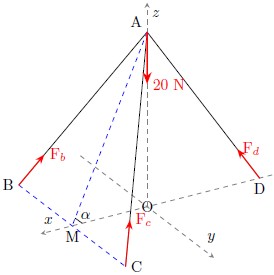
Problem 8: The two front legs of a tripod are each 1.4m long, with feet 0.8m apart. The third is leg 1.5m long, and and its foot is 1.5m directly behind the mid-point of the line joining the other two. Find the height of tripod, and the vectors representing the positions of its three feet relative to the top. Given that the tripod carries a mass of 2kg, find the forces in the legs, assuming they are purely compressional and that the legs themselves have negligible weight.
Other Solutions
| Problem 10 |
Chapter 2 Linear Motion
Featured Solutions
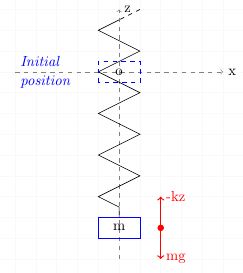
Problem 2: A weight of mass \(m\) is hung from the end of a spring which provides a restoring force equal to \(k\) times its extension. The weight is released from rest with the spring unextended. Find its position as function of time, assuming negligible damping.
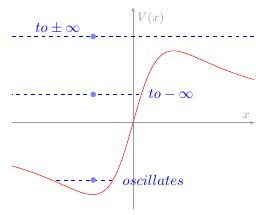
Problem 12: The potential energy function of a particle of mass \(m\) is \(V=cx/(x^2+a^2)\), where \(c\) and \(a\) are positive constants. Sketch \(V\) as a function of \(x\). Find the position of stable equilibrium, and the period of small oscillations about it. Given that the particle starts from this point with velocity \(v\), find the range of values of \(v\) for which it (a) oscillates, (b) escapes to \(-\infty\), and (c) escapes to \(+\infty\).
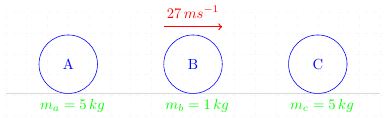
Problem 27: Three perfectly elastic bodies of masses 5kg, 1kg, 5kg are arranged in order on a straight line, and are free to move along it. Initially, the middle one is moving with velocity 27ms\(^{-1}\), and the others are at rest. Find how many collisions take place in the subsequent motion, and verify that the final value of the kinetic energy is equal to the initial value.
Other Solutions
| Problem 13 | Problem 18 | Problem 24 |
| Problem 30 |
Chapter 3 Energy and Angular Momentum
Featured Solutions
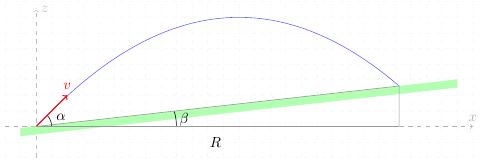
Problem 7: Find the equation for the trajectory of a projectile launched with velocity \(v\) at an angle \(\alpha\) to the horizontal, assuming negligible atmospheric resistance. Given that the ground slopes at an angle \(\beta\), show that the range of the projectile measured horizontally is \[ x= \frac{2v^2}{g}\frac{sin(\alpha-\beta)cos\alpha}{cos\beta} \] At what angle should the the projectile be launched to achieve maximum range?
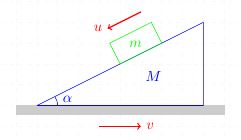
Problem 14: A wedge-shaped block of mass \(M\) rests on a smooth horizontal table. A small block of mass \(m\) is placed on its upper face, which is also smooth and inclined at an angle \(\alpha\) to the horizontal. The system is released from rest. Write down the horizontal component of momentum, and the kinetic energy of the system, in terms of the velocity \(v\) of the wedge and the velocity \(u\) of the small block relative to it. Using conservation of momentum and the equation for the rate of change of kinetic energy, find the accelerations of the blocks. Given that \(M\)=1kg and \(m\)=250g, find the angle \(\alpha\) that will maximize the acceleration of the wedge.
Problem 15: A particle starts from rest and slides down a smooth curve under gravity. Find the shape of the curve that will minimize the time taken between two given points. Take the origin as starting point and the z-axis downwards. Show that the time taken is \[\int_0^{z_1} \left[\frac{1 + (dx/dz)^2} {2gz}\right]^{1/2}\,dz\] and hence that for a minimum \[\left(\frac{dx}{dz}\right)^2 = \frac{c^2z}{1 - c^2z}\] where c is a constant of integration. To complete the integration, use the substitution \(z = c^{-2}sin^2\theta\). This famous curve is known as the brachistochrone.
Other Solutions
| Problem 9 | Problem 17 | Problem 19 |
| Problem 25 |
Chapter 4 Central Conservative Forces
Featured Solutions
Problem 12: A star of mass M and radius R is moving with velocity \(v\) through a cloud of particles of density \(\rho\). If all the particles that collide with the star are trapped by it, show that the mass of the star will increase at a rate \[\frac{dM}{dt}= \pi\rho v \left(R^2 + \frac{2GMR}{v^2}\right)\] Given that M = 10\(^{31}\) kg and R = 10\(^8\) km, find how the effective cross-sectional area compares with the geometric cross-section \(\pi\,\)R\(^2\) for velocities of 1000 km s\(^{-1}\), 100 km s\(^{-1}\) and 10 km s\(^{-1}\).
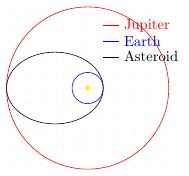
Problem 17: The orbit of an asteroid extends from Earth's to Jupiter's just touching both. Suppose that the asteroid approaches the Earth with an impact parameter of 5R\(_E\), where R\(_E\,\)= Earth's radius, moving in the same plane and overtaking it. Find the distance of closest approach and the angle through which the asteroid is scattered, in the frame of reference in which the Earth is at rest. (Assume that the asteroid is small enough to have negligible effect on the Earth's orbit.) What is its new velocity \(v\) relative to the Sun? Show that the semi-major axis of its new orbit is \(a_Ev_E^2/(2v_E^2 - v^2)\), where \(a_E\) and \(v_E\) are the Earth's orbital radius and orbital velocity. Find the asteroid's new orbital period.
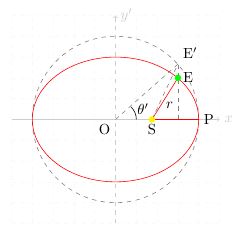
Problem 18: Show that the position of a planet in its elliptical orbit can be expressed, using a frame with x-axis in the direction of the perihelion, in terms of the angular parameter \(\psi\) by \(x=a(cos\psi-e),\,\) \(y=bsin\psi\). Show that \(r=a(1-ecos\psi)\), and that the time from the perihelion is given by \(t=(\tau/2\pi)(\psi-esin\psi)\) (Kepler's equation).
Other Solutions
| Problem 24 | Problem 29 |
Chapter 5 Rotating Frames
Featured Solutions
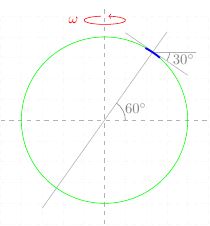
Problem 3: The water in a circular lake of radius 1km in latitude \(60^{\circ}\) is at rest relative to the Earth. Find the depth by which the centre is depressed relative to the shore by the centrifugal force. For comparison, find the height by which the centre is raised by the curvature of the Earth's surface.
Problem 5: The apparent weight of an aircraft when on the ground at the equator is 100 t. Assuming it is flying straight and at a constant altitude over the equator at 1000 km h\(^{-1}\), what is its apparent weight (a) if it flies north, (b) if it flies west, and (c) if it flies east?
Problem 19: The co-ordinates \((x,y,z)\) of a particle with respect to a uniformly rotating frame may be related to those with respect to a fixed inertial frame, \((x^*,y^*,z^*)\), by the transformation \[\begin{equation*} \begin{pmatrix} x\\ y\\ z \end{pmatrix} \,=\, \begin{pmatrix} cos\, \omega t & sin\, \omega t & 0\\ -sin\, \omega t & cos\, \omega t & 0\\ 0 & 0 & 1 \end{pmatrix} \begin{pmatrix} x^*\\ y^*\\ z^* \end{pmatrix} \end{equation*}\] Write down the inverse relation giving \((x^*,y^*,z^*)\) in terms of \((x,y,z)\). By differentiating with respect to \(t\), derive the relation between \( d^2 \mathbf{r}/dt^2\) and \(\ddot{\mathbf{r}}\).
Other Solutions
| Problem 9 | Problem 14 | Problem 15 |
Chapter 6 Potential Theory
Featured Solutions
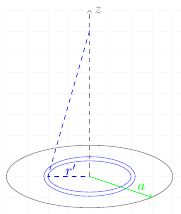
Problem 1: (a) Find the potential and electric field at points on the axis of symmetry of a uniformly charged flat circular disc of charge \(q\) and radius \(a\). What happens to the field if we keep the charge per unit area \(\phi=q/\pi a^2\) fixed, and let \(a\,\rightarrow\,\infty\)? (b) Calculate the quadruple moment of the disc and deduce the form of the field at large distances in any direction. Verify that on the axis it agrees with the exact value when \(r/a\) is sufficiently large.
Problem 8: Find the quadrupole moment of a distribution of charge on the surface of a sphere of radius \(a\) with surface charge density \(\sigma = \sigma_0 \left(\frac{3}{2}cos^2\theta - \frac{1}{2}\right)\). Find the total energy stored in this distribution.
Problem 20: Two small identical uniform spheres of density \(\rho\) and radius \(r\) are orbiting the Earth in a circular orbit of radius \(a\). Given that the spheres are just touching, with their centres in line with the Earth's centre, and that the only force between them is gravitational, show that they will be pulled apart by the Earth's tidal force if \(a\) is less than \(a_c = (2 \rho_E/\rho)^{1/3}\,R_E\), where \(\rho_E\) is the mean density of the Earth and R\(_E\) its radius.
Other Solutions
| Problem 9 | Problem 15 | Problem 24 |
Chapter 7 The Two-Body Problem
Featured Solutions
Problem 1: A double star is formed of two components, each with mass equal to that of the Sun. The distance between them is 1 AU. What is the orbital period?
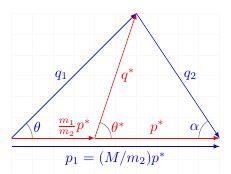
Problem 7: An experiment is to be designed to measure the differential cross-section for elastic pion-proton scattering at a CM scattering angle of \(70^{\circ}\) and a pion CM kinetic energy of 490 KeV. Find the angles in the Lab at which the scattered pions, and the recoiling protons, should be detected, and the required Lab kinetic energy of the pion beam. (The ratio of pion to proton mass is 1/7.)
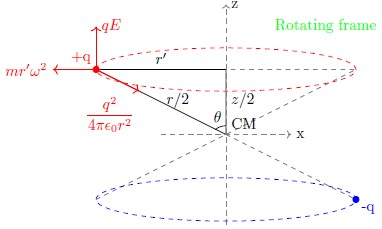
Problem 17: Write down the equations of motion for a pair of charged particles of equal masses \(m\), and of charges \(q\) and \(-q,\) in a uniform electric field \(E\). Show that the field does not affect the motion of the centre of mass. Suppose that the particles are moving in circular orbits with angular velocity \(\omega\) in planes parallel to the xy-plane, with \(E\) in the z-direction. Write the equations in a frame rotating with angular velocity \(\omega\), and hence find the separation of the planes.
Other Solutions
| Problem 3 | Problem 8 | Problem 15 |
Chapter 8 Many-Body Systems
Featured Solutions
Problem 4: If the residual mass of a rocket, without payload or fuel, is a given fraction \(\lambda\) of the initial mass including fuel (but still without payload). The total take-off mass required to accelerate a payload \(m\) to velocity \(v\) with an ejection velocity \(u\) is \[ M_0 = m\frac{1-\lambda}{e^{-v/u} - \lambda} \] Find an analogous formula for a two-stage rocket, in which each stage produces the same velocity impulse. (The first-stage rocket is discarded when its fuel is burnt out.) If \(\lambda\) = 0.15 and the ejection velocity is 2.5 km/s, what is the minimum number of stages required to reach escape velocity (11.2 km/s)? With that number, what take-off mass is required, if the payload mass is 100 kg?
Problem 6: Find the gain in kinetic energy when a rocket emits a small amount of matter. Hence calculate the total energy which must be supplied from chemical or other sources to accelerate the rocket to a given velocity. Show that this is equal to the energy required if an equal amount of matter is ejected while the rocket is held fixed on a test-bed.

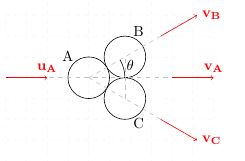
Problem 9: Two billiard balls are resting on a smooth table, and just touching. A third identical ball moving along the table with velocity \(v\) perpendicular to their line of centres strikes both balls simultaneously. Find the velocities of the three balls immediately after impact, assuming the collision is elastic.
Other Solutions
| Problem 2 | Problem 7 | Problem 11 |
| Problem 14 |
Chapter 9 Rigid Bodies
Featured Solutions
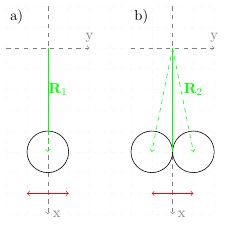
Problem 4: A pendulum consists of a light rigid rod of length 250mm, with two identical uniform solid spheres of radius 50mm attached one on either side of its lower end. Find the period of small oscillations (a) perpendicular to the line of centres, and (b) along it.
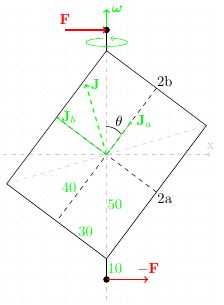
Problem 7: Find the principal moments of inertia of a flat rectangular plate of mass 30g and dimensions 80mm × 60mm. Given that the plate is rotating about a diagonal with angular velocity 15 rads s-1, find the components of angular momentum parallel to the edges. Given that the axis is of total length 120mm, and is held vertical by bearings at its ends, find the horizontal component of the force on each bearing.
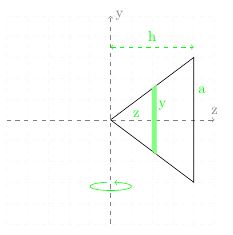
Problem 12: Calculate the principal moments of inertia of a uniform, solid cone of vertical height \(h\), and base radius \(a\) about its vertex. For what value of the ratio \(h/a\) is every axis through the vertex a principal axis? For this case, find the position of the centre of mass and the principal moments of inertia about it
Other Solutions
| Problem 2 | Problem 8 | Problem 16 |
| Problem 17 |
Chapter 10 Lagrangian Mechanics
Featured Solutions
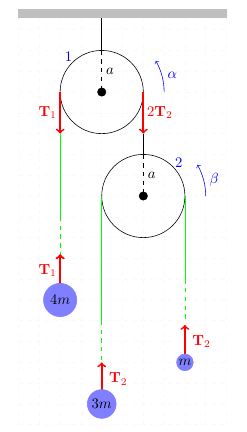
Problem 6: A light inextensible string passes over a light smooth pulley, and carries a mass of 4\(m\) on one end. The other end supports a second pulley with a string over it carrying masses 3\(m\) and \(m\) on the two ends. Using a suitable pair of generalized co-ordinates, write down the Lagrangian function for the system, and Lagrange's equations. Find the downward accelerations of the three masses and also the tensions in the strings. Explain why the first pulley turns, although the total mass on each side is the same.
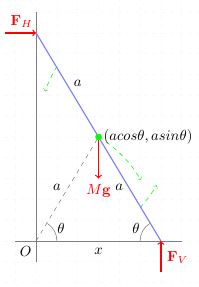
Problem 12: A uniform plank of length 2\(a\) is placed with one end on a smooth horizontal floor and the other against a smooth vertical wall. Write down the Lagrangian function, using two generalized co-ordinates, the distance \(x\) of the foot of the plank from the wall, and its angle \(\theta\) of inclination to the horizontal, with a suitable constraint between the two. Given that the plank is initially at rest at an inclination of 60\(^{\circ}\), find the angle at which it loses contact with the wall.
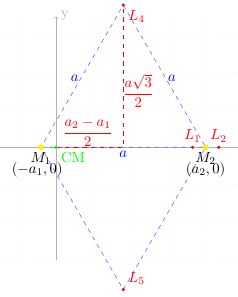
Problem 16: Two bodies of masses \(M_1\) and \(M_2\) are moving in circular orbits of radii \(a_1\) and \(a_2\) about their centre of mass, a third small body of mass \(m\)(<<\(M_1\) or \(M_2\)) is moving in the gravitational field of the first two and in the same plane. Find the equations that must be satisfied for ‘equilibrium’ in the rotating frame (i.e. circular motion with the same angular velocity as \(M_1\) and \(M_2\)). Consider ‘equilibrium’ positions on the line of centres of \(M_1\) and \(M_2\). By roughly sketching the effective potential energy curve, show that there are three such positions, but that all three are unstable. Show also that there are two ‘equilibrium’ positions off the line of centres, in each of which the three bodies form an equilateral triangle. (Lagrangian points.)
Other Solutions
| Problem 4 | Problem 8 | Problem 9 |
| Problem 11 |
Chapter 11 Small Oscillations and Normal Modes
Featured Solutions
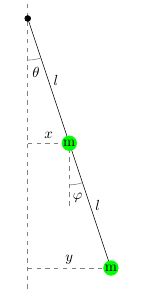
Problem 1: A double pendulum, consisting of a pair, each of mass \(m\) and length \(l\), is released from rest with the pendulums displaced but in a straight line. Find the displacements of the pendulums as functions of time.
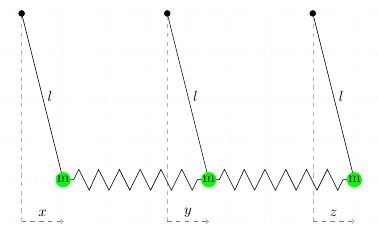
Problem 4: (a)Three identical pendulums are coupled with springs between the first and second and between the second and third. Find the frequencies of the normal modes, and the ratios of amplitudes. (b) The first of the three pendulums is initially displaced a distance \(a\), while the other two are vertical. The system is released from rest. Find the maximum amplitudes of the second and third pendulums in the subsequent motion.
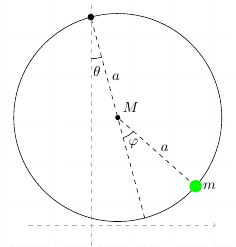
Problem 7: A bead of mass \(m\) slides on a smooth circular hoop of mass \(M\) and radius \(a\), which is pivoted at a point on the rim so that it can swing freely in its plane. Write down the Lagrangian in terms of the angle \(\theta\) of the diameter through the pivot and the angular position \(\varphi\) of the bead relative to a fixed point on the hoop. Find the frequencies of the normal modes, and sketch the configuration of the hoop and bead at the extreme point of each.
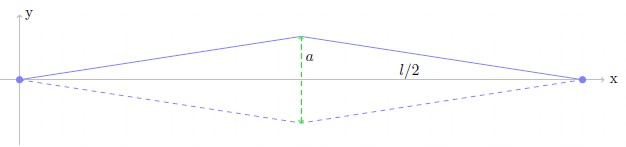
Problem 14: Show that a stretched string is equivalent mathematically to an infinite number of uncoupled oscillators, described by the co-ordinates \[ q_n(t) = \sqrt{\frac{2}{l}} \int_0^l y(x,t) sin \frac{n\pi x}{l} dx\,.\] A string of length \(l\), fixed at both ends, is released from rest with its mid-point displaced a distance \(a\) and each half of the string straight, determine the amplitudes of the various normal modes. Why, physically, are the modes for even values of \(n\) not excited?
Other Solutions
| Problem 12 | Problem 13 | Problem 15 |
Chapter 12 Hamiltonian Mechanics
Featured Solutions
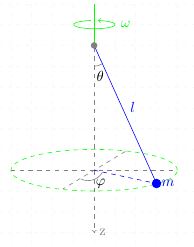
Problem 2: A light rigid rod, of length \(l\), carrying a mass \(m\) at one end, is hinged at the other to a vertical axis, so that it can swing freely in a vertical plane. A torque is applied to the vertical axis and adjusted to constrain the system to rotate with constant angular velocity \(\omega\). Find the Hamiltonian function for the system, and verify that it is equal to \(T^{\prime} + V^{\prime}\). Determine the frequency of small oscillations about the stable ‘equilibrium' position when \(\omega^2 > g/l\).
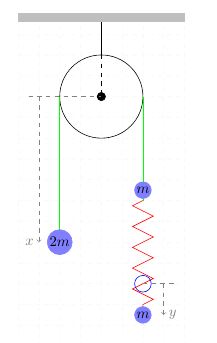
Problem 3: A light, inextensible string passes over a small pulley and carries a mass 2\(m\) on one end. On the other end is a mass \(m\), and beneath it, supported by a spring with spring constant \(k\), a second mass \(m\). Find the Hamiltonian function, using the distance \(x\) of the first mass beneath the pulley, and the extension \(y\) in the spring, as generalized co-ordinates. Show that \(x\) is ignorable. To what symmetry property does this correspond? If the system is released from rest with the spring unextended, find the positions of the particles at any later time.
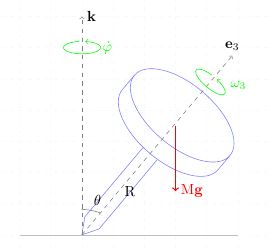
Problem 6: Obtain the Hamiltonian function for a symmetric top, whose pivot is free to slide on a smooth horizontal table, in terms of the generalized co-ordinates \(X,\,Y,\,\varphi,\,\theta,\,\psi\), and the principal moments \(I_1^*,\, I_2^*,\, I_3^*\). Find whether the minimum angular velocity required for stable vertical motion is greater or less than in the case of a fixed pivot. Can you explain this result physically?
Other Solutions
| Problem 1 | Problem 11 | Problem 15 |
| Problem 17 |
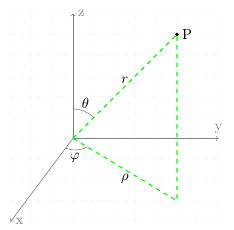
Appendix A Co-ordinate Systems for Physics
Some of the problems in this book are quite challenging. I'm not sure all my solutions are correct - comments welcome!
J D Cain